Is an RV Rental Business Profitable? The Math for One Unit
An RV rental business can make money, but not by default. Whether one unit does comes down to the nights it books, the rate it earns, and the fixed costs you pay each month whether it rents or not.
By the RV Shop Desk team · · 7 min read
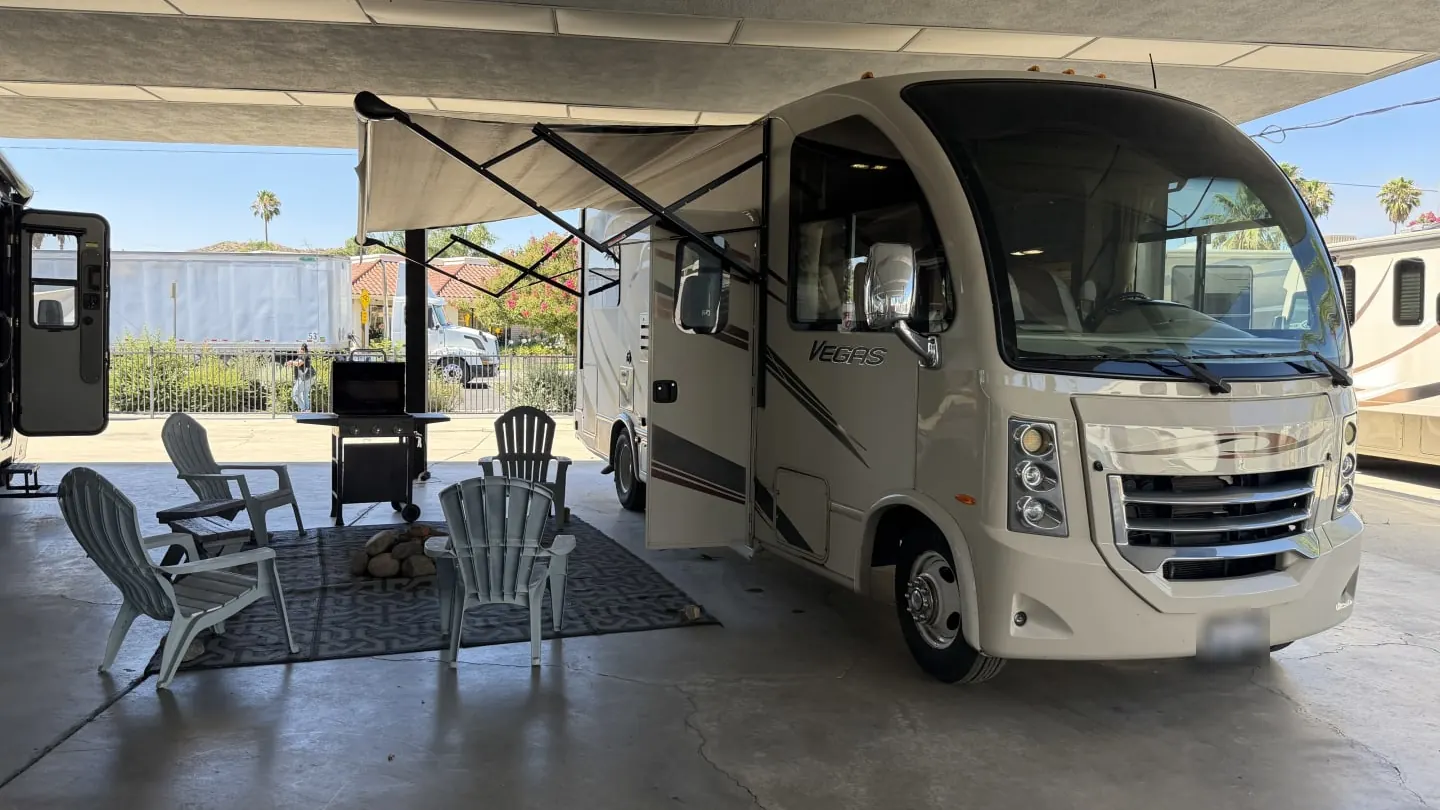 Real rental fleet photo
In this guide
An RV rental business can be profitable. Whether yours is comes down to three numbers. Those are the nights each unit books, the rate it earns, and the fixed costs you pay every month even when it sits.
Plenty of owners see a busy calendar and assume they are making money. Then tax time comes and the math says otherwise. This guide walks through one unit's numbers, line by line, so you can see where the money goes. Every dollar figure here is an example. Swap in your own before you decide anything.
The Three Numbers That Decide It
Before the table, it helps to know what drives the result. Almost every profit question comes back to these.
- Booked nights: how many nights a paying renter has the unit. This is the biggest lever you have.
- Average rate: what you actually get per night after discounts, not the price on your website.
- Fixed costs: the payment, insurance, storage and registration you owe whether the unit rents or not.
There is a fourth group too. Some costs only show up when a trip happens. Cleaning, card fees, marketplace fees and wear all rise with every booking. Those are your per-trip costs, and they set how much of each night you keep.
One Unit's Math, Line by Line
Here is a sample year for one used Class C motorhome. Say it books 100 nights at an average of $200 a night. Half the nights come through a marketplace and half come direct. Trips average four nights, so that is 25 trips.
| Example line | How it is figured | Example amount |
|---|---|---|
| Rental revenue | 100 nights x $200 | $20,000 |
| Marketplace fees | Example 15% on the $10,000 booked there | -$1,500 |
| Card payment fees | Example 3% on the $10,000 booked direct | -$300 |
| Cleaning and supplies | 25 trips x $60 | -$1,500 |
| Maintenance reserve | $20 set aside per booked night | -$2,000 |
| Loan payment | $450 a month x 12 | -$5,400 |
| Insurance | Example yearly premium for rental use | -$2,400 |
| Storage | $100 a month x 12 | -$1,200 |
| Registration | Example yearly fee | -$300 |
| Depreciation | Example value the unit loses in a year | -$3,000 |
| What is left | Revenue minus all costs | $2,400 |
These are example figures only. Your rates, fees, premiums and payment will differ, and so will your state's rules.
Look at what that table says. The unit brought in $20,000 and kept $2,400. That is a real profit, but a thin one. One bad repair or ten fewer nights wipes it out.
A note on the loan and depreciation lines. Part of each payment pays down the loan, so you own more of the unit each year. Depreciation is the value the unit loses as it ages. Counting both gives you a careful view of the year. How they are treated for taxes is a question for your accountant. For a full list of what goes into the first year, see what it costs to start an RV rental business.
Break-Even Nights for This Example
Break-even is the number of booked nights where the unit stops losing money. Here is how to find it.
- Add up the per-trip costs and divide by booked nights. In the example, fees, cleaning and the repair reserve come to $5,300. That is $53 a night.
- Subtract that from your average rate. At $200 a night, you keep $147 from each booked night.
- Add up the fixed costs. The payment, insurance, storage, registration and depreciation come to $12,300.
- Divide fixed costs by what you keep per night. $12,300 divided by $147 is about 84 nights.
So this unit needs about 84 booked nights just to cover itself. Every night after that adds about $147. Every night short of it costs you about $147.
If you leave out depreciation and look only at cash, the fixed costs drop to $9,300. Break-even falls to about 64 nights. That is the number that tells you whether you can make the payment. The 84 is the number that tells you whether the unit is a good use of your money.
Now watch what the rate does. Drop the average from $200 to $170 and you keep $117 a night instead of $147. Break-even jumps from 84 nights to about 105. A $30 discount sounds small on one booking. Across a season it can turn a profit into a loss. That is why a sale to fill one slow week is fine, but a lower rate all year needs a hard look.
Tip: Run break-even before you buy a unit, not after. If the nights you need are more than similar units book in your area, the rate or the price of the unit has to change.
What Moves Profit the Most
Once you know the math, you can see which changes matter. Some are worth far more than others.
Booked Nights
Nothing moves profit like booked nights. In the example, 20 more nights adds close to $3,000. That can double the year. Most of those extra nights come in spring and fall, not in July. Shoulder season rates, shorter minimum stays and weekday deals help fill them. The guide on pricing by night, season and mile shows how to set them.
Direct Bookings
In the example, the marketplace nights cost $1,500 in fees. The same nights booked direct cost about $300 in card fees. Moving even a third of those trips to your own site adds real money. It does take a website that books, reviews and a phone you answer. Read balancing marketplaces and direct bookings before you pull back from either one.
Turnover Time
Every day a unit sits between trips waiting to be cleaned is a night it could have booked. If your turnover takes two days and could take one, you lose nights on every busy weekend. A written turnover checklist makes the work faster and more even. Tight calendar buffers keep the gap as short as it can safely be.
Repairs
A $2,500 repair in July does two kinds of damage. It costs the repair, and it takes the unit off the calendar in peak season. Regular preventive maintenance costs less than a breakdown and a canceled trip. Dated photos at pickup and return also help you recover the cost when a renter causes damage. See handling deposits and damage claims.
The Off-Season
The payment, insurance and storage keep coming all winter. If your unit books zero nights from November to March, your summer has to carry five months of fixed costs. Winter trips, snowbird rentals or a lower storage rate all help. The off-season guide covers what owners do with those months.
Mistakes That Make a Busy Unit Lose Money
A full calendar does not mean a profitable unit. These are the ways owners lose money while staying busy.
- Pricing to match the cheapest listing: another owner's low rate may be built on a paid-off unit or no insurance. Price from your own break-even.
- Lots of one-night and two-night trips: every trip costs a full clean and a walk-around. Short trips can eat the night's profit. Set a minimum stay, at least on weekends.
- Not charging for miles and generator hours: wear on the engine and generator is real. If you do not charge for it, you pay for it later.
- Skipping the repair reserve: the money for tires, batteries and a roof reseal has to come from somewhere. Set it aside per night so it is there.
- Letting damage go: without dated photos, small damage becomes your cost. Over a season, that adds up.
- Leaving out your own time: if you do every clean and delivery yourself, the unit looks more profitable than it is.
- The wrong insurance: a personal policy that does not cover rental use can turn one claim into the whole year's profit. Read what to ask your insurance agent first.
How to Know Your Real Number Each Month
The example above is a plan. Your real number comes from your books. Track income and costs by unit, not just for the business as a whole. A fleet can look fine overall while one unit loses money every month. The guide to profit-per-unit bookkeeping shows how to set up the categories.
Check three things each month. Look at booked nights per unit, what you kept per night, and how far each unit is above or below break-even. After a full season, those numbers also tell you when to add another RV. If you plan to borrow for it, read financing RVs for a rental business first.
RV Shop Desk keeps bookings, the calendar, turnovers, invoices and card payments for each rig in one record. Accounting is built in, so costs sit next to the trips they belong to. It costs $9 per rental unit a month with a five-unit minimum. Smaller fleets can email [email protected]. The details are on the RV rental software page.
So, Is It Worth It?
For an owner who prices from real costs, keeps turnovers tight and books enough nights, yes. For an owner who guesses, a busy summer can still end in a loss. The difference is not luck. It is knowing your break-even nights and checking them every month. Run the math on your own unit first, and let the numbers make the call.
Questions owners ask
How much can one rental RV make in a year?
It depends on your booked nights, your rate and your costs. A unit that books 100 nights at $200 brings in $20,000 before costs in our example. What you keep after fees, the payment, insurance and repairs is the number that matters.
How many nights does an RV need to rent to pay for itself?
Divide your yearly fixed costs by what you keep from each booked night. In the example in this guide, that works out to about 84 nights. Your number will be different, so run it with your own costs.
Do motorhomes or trailers make more money as rentals?
Motorhomes often rent for more per night, but they cost more to insure, repair and keep on the road. Trailers cost less to own and can be delivered, so the renter never drives them. Compare what each one keeps per night, not just the rate.
Is it better to rent my RV myself or through a marketplace?
A marketplace can bring renters fast, but it takes a fee on every trip. Direct bookings keep more of each night but need a website, reviews and someone to answer the phone. Most owners start with both and move toward direct over time.
Should I count my own time as a cost?
Yes. If you clean, deliver and do the walk-arounds yourself, put a fair hourly value on that work. If you ever hire help, that cost shows up, and the unit has to still make money after it.